A resource by Mama's Kefir
What is Kefir?
The complete guide to the world's most microbially diverse fermented drink — its origins, its science, and what it can quietly do for a body that welcomes it in.
Quick answer
Not yogurt. Not lassi. Not mohi.
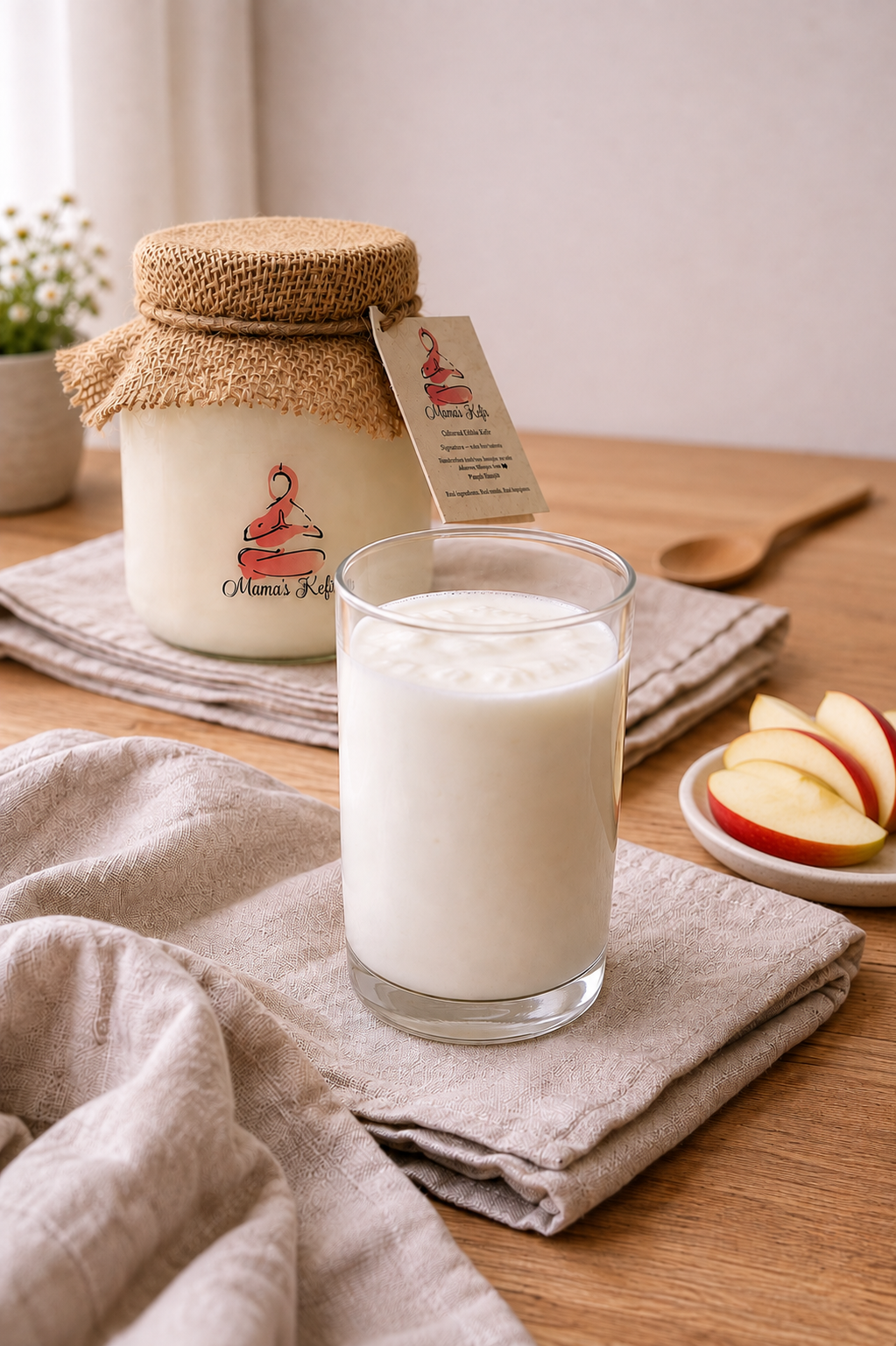
Kefir is a lightly tangy, gently effervescent fermented milk drink made by adding living cultures called kefir grains to fresh milk and letting them work for roughly 18 to 24 hours.
It is fermented by a symbiotic community of dozens of bacteria and yeasts living together, whereas yogurt is typically made with two to six bacterial strains alone. That difference in the culture is the reason kefir has a thinner, drinkable texture, a slight natural fizz, a fuller sour-creamy flavour, and a far broader microbial profile than any other fermented dairy in common use.
If you have grown up on dahi and mohi, kefir will not feel foreign. It belongs to the same family of living, fermented dairy foods that Nepali kitchens have relied on for generations.
Origins
Where kefir comes from
Kefir originated in the Caucasus Mountains, between the Black Sea and the Caspian, in the region now spanning Georgia, Armenia, Azerbaijan and southern Russia — the literature places its beginnings some three thousand years ago.
The method was practical, not scientific. Milk was stored in leather bags or clay vessels; the microbial community living in those vessels fermented it; and over generations the culture concentrated into stable, reusable clusters passed between families as a household inheritance. The name traces to a Turkic root meaning something close to pleasant.
From the Caucasus it spread through Eastern Europe and Russia, then into Western Europe, North America, Australia and East Asia. Today it is among the most researched fermented foods in the world. In Nepal, kefir is still new — not new science, and not a wellness trend, but a three-thousand-year-old food that simply has not arrived here in volume yet.
The culture
What kefir grains actually are
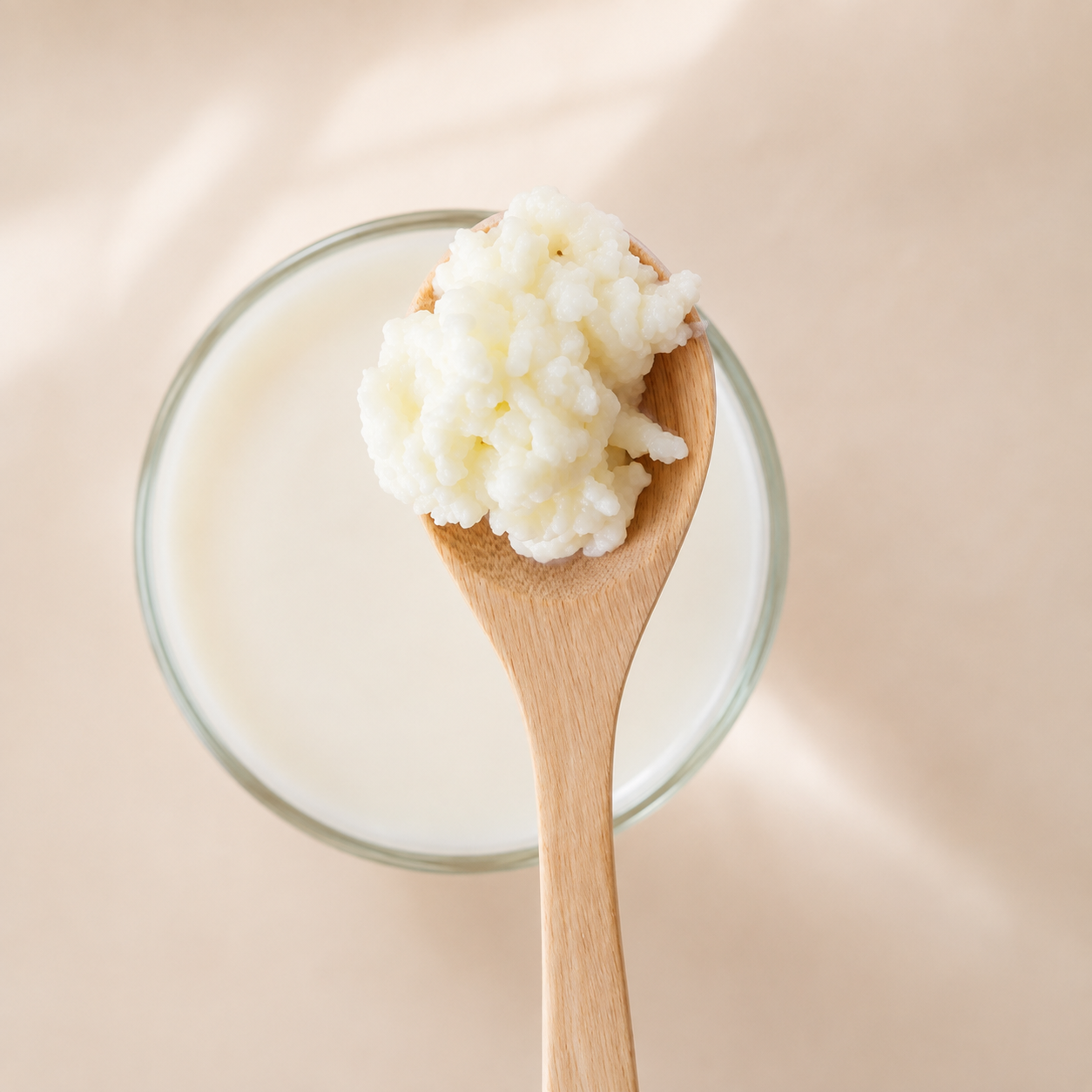
Despite the name, kefir grains contain no cereal. They are soft, cauliflower-like clusters — a SCOBY (Symbiotic Culture of Bacteria and Yeasts) — holding 20 to 60 living species.
65–80%
Lactic acid bacteria
Lactobacillus · Lactococcus · Leuconostoc · Streptococcus
10–30%
Yeasts
Saccharomyces · Kluyveromyces · Candida
8–20%
Acetic acid bacteria
Chiefly Acetobacter
Process
How kefir is made
The principle is ancient and elegantly simple, which is precisely why kefir survived for three thousand years in households that had no laboratories, no thermometers and no refrigeration.
Fresh milk. Living kefir grains. Time.
That is the whole of it. The grains are introduced to good milk and then left to work. No heating, no starter powder, no acid, no thickener, no shortcut. The microbial community inside the grains does everything — consuming lactose, producing lactic acid, thickening the milk, generating carbonation, and building compounds that were not present when the process began.
When fermentation reaches the character we want, the grains are lifted out. What remains is kefir. The grains themselves never reach the bottle; they are returned to fresh milk to begin again, as they have been for generations.
Why this differs from yogurt production
Yogurt is made by heating milk, adding a measured powdered starter, and holding it at 40 to 45°C for several hours — a precise, thermophilic process. Kefir ferments at ambient temperature using a living, self-sustaining culture. Nothing is heated during fermentation. The grains do the regulating.
This is also why true kefir resists industrialisation. A great deal of what is sold internationally as "kefir" is made from freeze-dried powdered starters instead of real grains — easier to scale, considerably simpler microbially. Mama's Kefir is fermented with real, living grains, in small batches. That is a production decision, not a marketing line.
Science
The four transformations of fermentation
Fermentation is not spoilage. It is controlled microbial transformation, and it changes milk in four ways.
Lactose is consumed
Milk sugar is the fuel. Lactic acid bacteria break it down using β-galactosidase, converting it to lactic acid. This is why kefir tastes tangy, carries less sugar than the milk it began as, and sits better with people who struggle with plain milk.
Acid is produced
Falling pH creates the clean sour flavour, partially coagulates milk proteins into kefir's drinkable body, and makes the environment hostile to spoilage organisms. Fermentation is, historically, a preservation technology.
Yeasts add carbonation
The yeast fraction produces carbon dioxide, giving kefir its faint natural effervescence, along with a trace of ethanol as a by-product — small, but real.
New compounds are created
The culture generates what was not in the milk to begin with: bioactive peptides, B vitamins (B12, riboflavin, folate, biotin), vitamin K2, organic acids, kefiran and digestive enzymes.
Fermentation is therefore additive, not merely subtractive. Kefir is not milk with less lactose. It is a nutritionally different food.
Nutrition
What's in a glass
Exact figures vary with the milk used, the fermentation time and the ambient temperature. Values below reflect plain, unsweetened whole-milk kefir and should be treated as a representative guide rather than a fixed specification.
Per 100 ml (approx.)
A note on protein quality
Kefir protein comes from casein and whey — the same complete proteins found in milk — with the added benefit that fermentation has already begun breaking them into smaller peptides. For many people this makes kefir feel lighter on the stomach than an equivalent volume of milk.
Kefir vs yogurt
The meaningful differences
Because both begin as milk, their base nutrition — protein, calcium, B12 — is broadly similar. The meaningful differences are microbial diversity, residual lactose and the presence of kefiran.
| Kefir | Yogurt | |
|---|---|---|
| Culture | Living kefir grains (SCOBY) | Powdered starter culture |
| Organisms | Bacteria and yeasts; 20–60 species | Bacteria only; 2–6 strains |
| Signature strains | L. kefiranofaciens, L. kefiri, Leuconostoc mesenteroides | L. bulgaricus, S. thermophilus |
| Fermentation | Room temperature, 18–24 hours | Heated milk at 40–45°C, several hours |
| Texture | Thin, drinkable, lightly effervescent | Thick, spoonable, still |
| Flavour | Tangy, creamy, faintly yeasty | Mild, clean sour |
| CFU per serving | ~25–30 billion | ~6 billion |
| Kefiran | Yes | No |
| Residual lactose | Lower | Higher |
| Culture reuse | Grains reused indefinitely | Starter added fresh |
For whom
Who kefir is for
Kefir is an everyday food, and it is a generous one. For most people, most days, it simply belongs in the fridge alongside the milk and the dahi.
For adults
One to two glasses a day is a comfortable, sustainable habit. Start with a small glass for the first week and build from there — not out of caution, but because your gut microbiome responds to kefir, and giving it a week to settle in makes the transition a pleasant one.
If milk doesn't agree with you
Kefir is often the happiest surprise. Fermentation consumes much of the lactose before the bottle ever reaches you, and the live cultures carry the enzyme that breaks down the rest. Many people who gave up on dairy find they can drink kefir comfortably. Start with a small glass and see.
For families
Plain pasteurised kefir is widely enjoyed by children in countries where it has been a staple for centuries — poured over fruit, blended into a mango smoothie, or stirred into breakfast. Begin with small servings, as with any new food, and check with your paediatrician before introducing it to babies and toddlers.
If you are pregnant or breastfeeding
Fermented dairy has a long and honourable place in traditional maternal diets. Our kefir is made from pasteurised milk under controlled conditions — and it's worth a quick word with your doctor or midwife, as with anything new during pregnancy.
The Benefits
A ritual for the whole body.
Gut Health & Digestion
- Rebalances your microbiome with beneficial bacteria
- Eases bloating, gas, acidity, and indigestion
- Enhances nutrient absorption naturally
Radiant Skin
- Feeds skin from within for a natural glow
- Rich in lactic acid to gently renew skin cells
- Calms inflammation and evens tone
Whole-Body Wellness
- Supports immunity through gut health
- Full of B12, K2, D, calcium and magnesium
- Sustained, calm energy throughout the day
A note on claims
Honest, in a market of overclaim.
Mama's Kefir presents kefir as what it is: a traditional fermented food with a nutritional profile, a live microbial culture, and a body of scientific research behind it that ranges from well established to genuinely preliminary.
We do not claim that kefir cures, treats or prevents disease. Where the evidence is strong, we say so. Where it is emerging, we say that instead. Nothing on this page is medical advice, and nothing here should replace consultation with a qualified healthcare professional — particularly if you are pregnant, breastfeeding, immunocompromised, taking prescription medication, or managing a diagnosed condition.
Trust compounds. Overclaiming does not.